
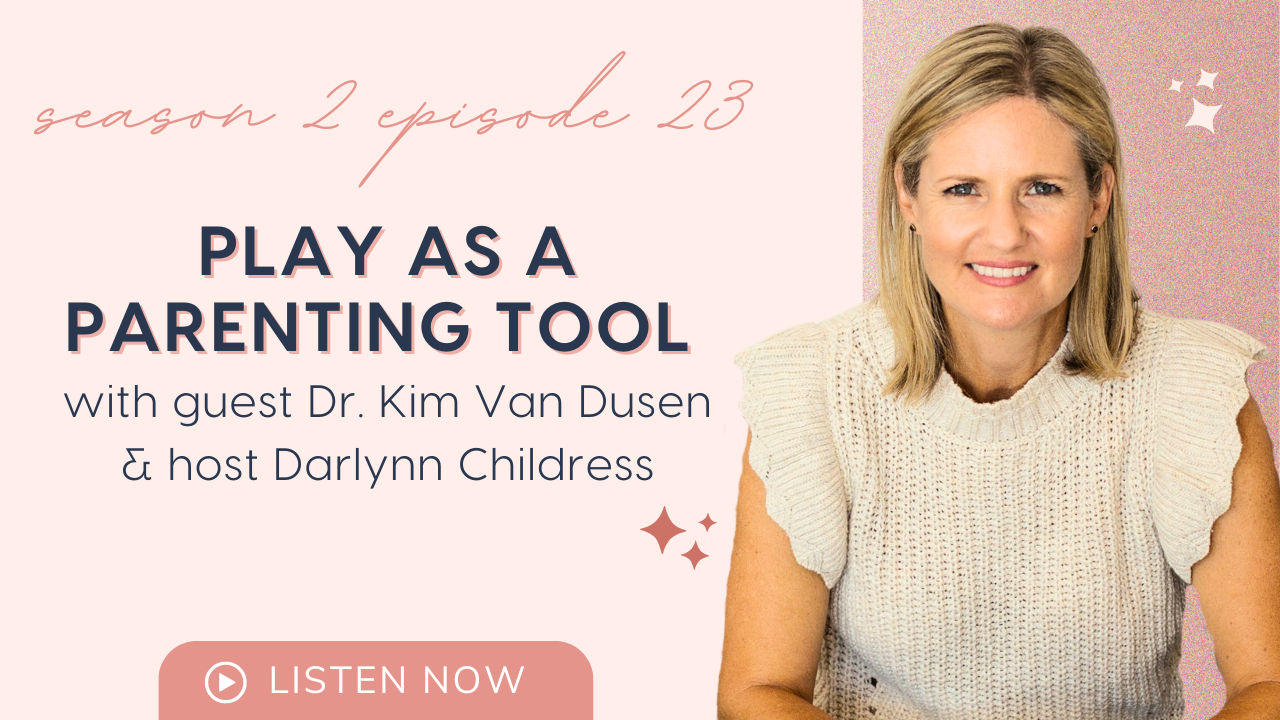
Play as a Parenting Tool with Dr. Kim Van Dusen
Jun 10, 2026Follow the Show
Apple Podcasts | Spotify | YouTube Podcasts | Everywhere else
Today, I've invited The Parentologist, Dr. Kim Van Dusen, to teach us about how to make parenting easier using play. We're talking about ways you can bring more play into your life and how to use play in your family in order to diffuse situations and make things less hard, less charged, and less complicated.
Dr. Kim Van Dusen is a licensed marriage and family therapist, registered play therapist, and parenting expert specializing in early childhood through adolescence. With more than two decades of experience as a clinician, educator, and public speaker, she works with families to support emotional regulation, positive behavior, and stronger parent–child relationships.
In her book, Parenting Through Play: Creative Strategies for Building Better Behavior, Deeper Connection, and Positive Communication, Dr. Kim walks parents through 3 evidence-based modalities: play therapy, solution-focused therapy, and positive behavior interventions and supports (PBIS).
She says that, "these three modalities are the trifecta of how to be the most effective teacher, coach, parent, or caregiver out there." Our conversation today focuses on play, but the 3 really work hand-in-hand.
Myths About Play
A lot of parents write off the concept of playful parenting because they think they aren't playful or silly enough. Or that play is for kids, and it's not acceptable to play as an adult. Or that they don't have the time and energy for it. Dr. Kim says, "I think a lot of us kind of forget how to play or forget what it feels like to play."
Here are some common myths - and the truth that goes along with them.
Myth #1: I'm just not a playful person.
Being playful doesn’t mean that you have to sit down on the floor and play cars or dolls or whatever in order to be playful with your child. It’s more of an energy, a tone that you set.
At its core, playful parenting is about saying "yes" more than you're saying "no". When you're able to say "yes" more often, there will be less pushback and defiance when you do say "no".
Dr. Kim shares that playfulness is actually a skill that you can learn and practice. And over time, it can become second nature.
Myth #2: I don't have the time or energy for play.
Here's the truth. Play takes time and energy. So do power struggles and tantrums. You have a choice. You either can choose the yelling and tears, or you can choose the more peaceful, playful route.
Playful energy can come out in so many different ways. Wearing the Santa hat to the Christmas party, putting music on and dancing in the kitchen. Look for the glimmers in your life.
And if you truly don't have the energy at all, think about more "passive" play. Dr. Kim shared a story of a tired mom whose daughter really wanted to play with her. Mom suggested "hair salon", and she sat still while her daughter brushed and styled her hair. Your presence is what your child is really after.
Myth #3: Play comes after the work is done.
It's easy to look at play as a reward. You can have fun after the homework and chores are done. But the truth is, if you put play first, all the other things fall into line much more easily.
Myth #4: Play is just for little kids.
Playful energy is good for all of us. It lightens the mood and helps us feel more connected. Even teens will respond to a bit of playfulness.
Think about when you naturally feel playful and have that energy. For me, it's in nature or telling silly stories with friends, or watching a funny show. Look for the glimmers in your day that bring you joy and delight.
Benefits of Play
First and foremost, play helps you to build a foundation of safety and trust with your child. Kids are motivated by having fun. They just want to have a good time. When you play, you are essentially speaking your child's language.
Play is essential for our kids' development, and it builds connection when you play with them. It helps children with their problem solving skills, communication skills, and social skills.
One benefit that surprises some parents is that you actually get more compliance when you're playful. If your kid is feeling good, they are more likely to say yes, to participate, to go with the flow. If they are in a playful state, they are more likely to engage and listen.
All of this leads to fewer power struggles, tantrums, and meltdowns. Less defiance and disrespect. They are much more likely to have better behavior and compliance, listen, follow directions, and make good choices.
Plus, play releases endorphins, serotonin, and dopamine - the happy hormones. It lowers your stress levels, improves your immune system, and helps you sleep better at night. It helps build confidence and competence in kids and even in your own parenting.
Obstacles to Playful Parenting
When you're in a moment of struggle or big feelings with your kid, it can be hard to come up with a way to bring in more play.
Not feeling creative. Dr. Kim is often asked, “But what if I'm not a creative parent?” Her response: "The creative side is probably in you. You just lost it over the years...You probably just forgot how creative you could be or how good it feels to play."
In her book, Dr. Kim offers simple strategies for all kinds of parenting situations, like tantrums, anxiety, and picky eating (so you don't have to come up with them all on your own). Many parents have started with strategies in the book and then put their own spin on it.
You can also think about what you really enjoyed as a child. Try going back to some of those activities and see if they still bring you joy today.
Overwhelm. Parenting is a lot, and it can feel heavy and overwhelming. It's easy to get sucked into paying the mortgage and making the dentist appointments and going grocery shopping and folding the laundry. These things can bog us down.
Use CALM breaks to settle your nervous system. Being in the moment - not in the future or the past - allows you to more easily access playful energy.
Resistance from your child. When a child is having big feelings, I recommend trying out play. Test out a little playfulness to see how they respond. If they resist, it might be a clue that they need some connection and validation first.
Use the Connection Tool to name and validate their feelings. Then, you can ask them what they need from you. Do they want a hug, or a little space? Dr. Kim shares that some kids like to set a timer and have you check back in with them after 5 or 10 minutes.
It's like a dance. Be as attuned as you can to your kid. Try something out. If it's not working, back off, give it a minute, and try again.
Ways to Play
There are so many ways to incorporate more playfulness into parenting and everyday life. Here are a few favorites.
If you’re trying to bring fun into a not-so-fun situation, I also find it helpful to acknowledge that the thing they have to do is not fun by itself. Chores aren't fun. Getting out of the shower stinks. It's not great.
But you can empower your child by bringing them in. Do you want to make it fun? How can we make this fun together?
Gamify. You don't need fancy prizes to turn chores (or anything your kids don't want to do) into a game. Dr. Kim shared the example of her kids not wanting to do chores, so she said, "I'm going to jump in and do some chores, too. We're all going to do it together. Whoever gets done first gets to stay up 15 minutes later tonight." Her kids (ages 9 & 12) got really into it and were in a runner's pose on an imaginary starting line asking her to count them down.
If both/all kids do a great job or finish around the same time, they can both be winners. For example, one can be the most efficient, or maybe one was most thorough or had the best attitude. Or you can keep a record of each child's personal best for specific chores and have them race against themselves.
Use your imagination. Dr. Kim shared some examples about trouble at dinnertime. One night, her son wasn't eating, so she replaced his fork with a pair of tongs. He thought it was really fun, and ate more of his dinner. Another night, her son was really tired, so her husband pretended to put batteries in his back and wind him up to give him more energy.
Small, simple shifts like these can turn the whole day or night around.
Give choices. In another example, a boy didn't want to get out of the shower (been there!), so his mom said to him, "I'm going to give you a choice. You can pick whatever animal you want to be while you're getting out of the shower." He chose a lion, and roared all the way to his bedroom to put his pajamas on.
Choices help kids feel empowered, like they have some control over their circumstances. And you can offer choices within limits that are acceptable to you as a parent.
Express feelings creatively. For example, ask your kid to scribble out their anger on a piece of paper and give it a name. Or they can turn it into a monster. This helps them to externalize their feelings.
Encourage independence. As we head into summer, Dr. Kim also shared some ideas for independent, outdoor play for kids, like building a fort, going on a scavenger hunt, or putting together and unraveling a rubber band ball.
The Takeaways
Like with any strategy, play doesn't work every time for every child in every situation. But Dr. Kim says it works more often than not. She shares that parents are often surprised by how well play works and how happy and peaceful things can be.
Keep it simple. You don't have to sit with your child and play with them all the time. You don't have to entertain them all the time. You don't have to be hands-on all the time.
Trust that your kid can find their own play and their own delight. That's their work. Independent play (and even a little boredom) are good things. Let your kids come up with their own games and play. That's often where the best imaginative games come to life.
When in doubt, ask yourself, "How can we make this fun?"
You'll Learn:
- Why play is such a powerful parenting tool
- 4 common myths about play - and the truth behind them
- The moment when Dr. Kim leaned into play with her kids and why it still stands out in her memory years later
- How to fit “purposeful play pockets” into everyday life
Connect with Dr. Kim:
- Get the book: Parenting Through Play: Creative Strategies for Building Better Behavior, Deeper Connection, and Positive Communication
- Follow her on IG @TheParentologist
- Learn more about Dr. Kim’s work on her website
- Listen to The Parentologist podcast
Ready to stop yelling?
Get the one simple tool you need to stop yelling at your kids, so you finally feel calmer and connect better.
You'll learn why you yell, how to stop yourself yelling, 40 things to do instead and scripts for what to say to your kid when you yell.
