
Help Kids Manage Big Feelings | The Connection Tool (Improved)
Apr 22, 2026Follow the Show
Apple Podcasts | Spotify | Everywhere else
The Connection Tool is one of my favorite tools I’ve ever created to help parents emotionally coach their kids when they're having big feeling cycles or when they're dysregulated. Today, I’ll walk you through exactly how to use it. And if you’ve been around a while, you may notice a few improvements.
The Connection Tool falls under the 2nd pillar of my Connected Parenting Process:
Calm >> Connect >> Limit Set >> Correct
This process is meant to simplify parenting for you as much as possible. When you’re seeing off-track behavior, it means that some parenting is probably needed. And by going through the 4 steps of the process, you can use your kid’s behavior as a clue to what they might be feeling or needing.
The best way to improve your child's behavior on the outside is helping them understand how to cope and communicate with their big feelings on the inside.
Kids don’t know what to do with disappointment, anger, jealousy, and those other hard emotions. So, they complain, ignore you, run away from you, call names, hit their brother, etc. The Connection Tool helps you teach them how to handle those emotions in an appropriate way.
What Do I Mean By Connection?
When you hear the term “connection” as it relates to parenting, your mind might automatically go to the connection between you and your child. Of course, I want you to have a good relationship with your kid, but that’s not exactly what we’re talking about here.
When I talk about “connection” in the Connected Parenting Process, I’m really talking about the connection between your child’s behavior and their emotions. You’re helping to connect what’s happening on the inside and how it’s showing up outside of them through their behavior.
In essence, it’s about connecting your child to themself. Giving them an understanding and awareness of how they're thinking, how they're feeling, and helping them learn to manage their feelings in healthy ways. Emotional health and wellbeing always starts with awareness.
This is also called “emotional literacy”, which essentially means that they can understand what they are feeling, describe it with words, and express those emotions in health and appropriate ways that work for them, your family, and their community.
From there, they can also learn how to shift their thinking so that they have a better mindset about whatever is going on in their life.
One thing I want to point out is that when your child is in a big feeling cycle or acting out, they don’t need limits or correction (yet). What they need first is connection. Threatening, accusing, minimizing, or insulting are not helpful in this situation. They will only make your child more dysregulated.
The Connection Tool
I’ve been teaching this tool to parents for a long time, but through the process of writing my book, I realized that it was incomplete.
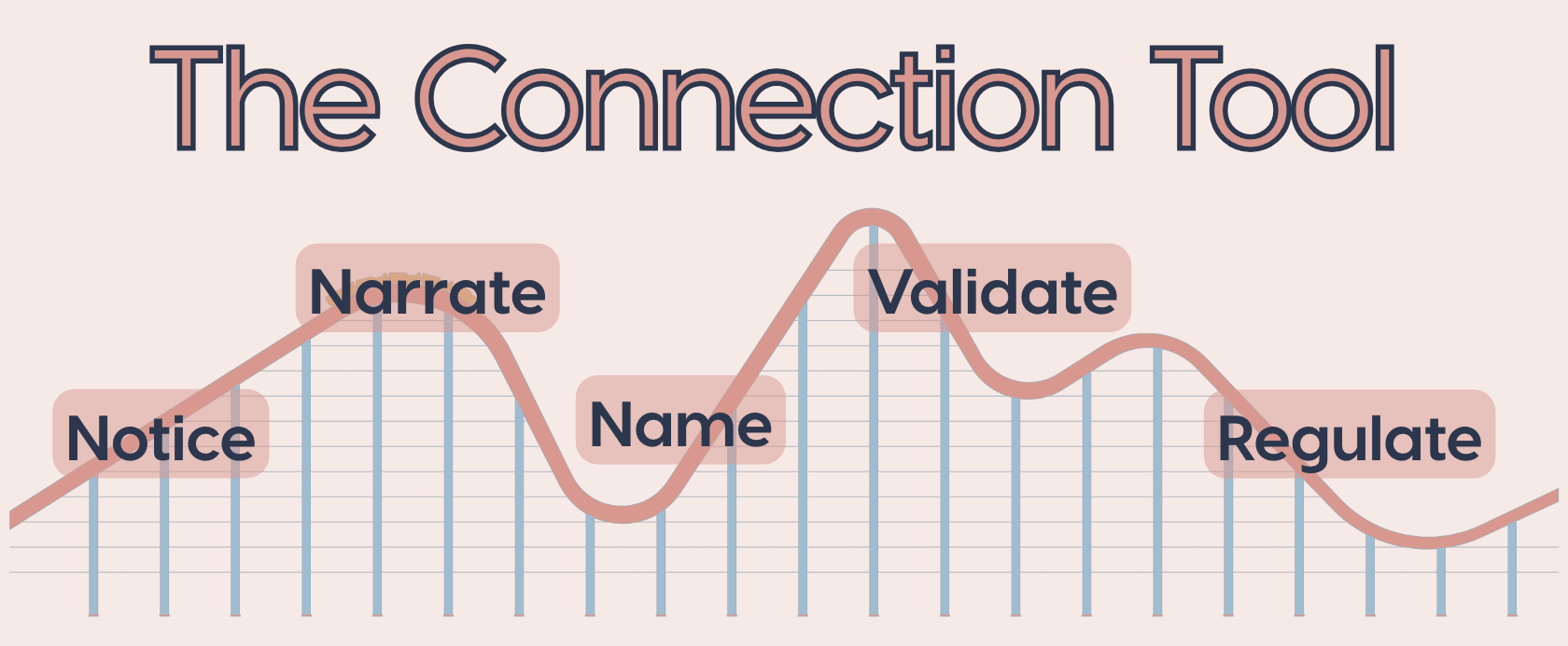
The NEW Connection Tool has 5 parts.
1. Notice. This is just for you. You notice that something is going on. Your kid is dysregulated or acting out. They might be tired, hungry, overstimulated, facing frustration. They're having feelings of stress, Frustration, anger, disappointment, disappointment.
Often, you’ll notice this before they really lose it. You’ll see that something is a little off, something’s brewing. Your kid looks mostly fine, but inside their nervous system is working really hard.
This is a great time for you to take a CALM break. You know that your kid is starting to show big feelings, and they’re going to need your help. If a behavior shows up and you find yourself upset by it or you start showing up with some of those less-than-helpful responses, those are also signs to take a break, get calm, and re-align with your goals.
2. Narrate. When somebody is dysregulated, they have exceeded their capacity to cope with their emotional upset in a healthy way. They no longer have access to logic. You can help bring them back into the moment by narrating the behavior you see.
For example:
“I am giving each of you dessert, but I saw you hit your brother because I gave it to him first.”
“I said that it was time to turn off the video game, and I noticed that you haven't done it yet.”
“I said it was homework time, but now I see that you’re playing in the backyard instead of sitting down at the table.”
You are narrating the circumstances and the specific actions and behaviors that you’re seeing. This is what's going on on the outside. Stick to the facts.
3. Name. Now, you name the feeling that’s happening on the inside. I like to phrase this as a question or curiosity. Like this…
“I wonder if you are feeling angry that I gave your brother the dessert first.”
“I wonder if you are sad that you don’t get to play video games any more.”
“I wonder if you are feeling annoyed that it's time to do homework.”
The narrating and the naming go together to help neutralize the behavior. It’s like holding up a mirror and saying, “Hey, I'm seeing this behavior and I'm thinking it's because of this circumstance.”
4. Validate. Now that the feeling has a name, let your child know that however they’re feeling is valid. Of course they’re feeling angry, sad, annoyed, etc.
One of my favorite phrases for this is, “That makes sense.”
5. Regulate. This is where you help your child move through the feeling so that they can get back to a state of calm. Ask, ”What are you going to do with that anger (or whatever emotion you’ve named together)?”
You can give suggestions. “Do you want to run around? Do you want to jump up and down? Do you want to talk about it? Do you want to tell me more things? Do you need to take a break from the family?” Let them know that you can help them or they can do it on their own.
There are a ton of different ways to regulate the nervous system, but moving the body is almost always a great starting point. It helps to push those emotions through and out of the body. Imagine it like an electrical current that is all charge up and needs to be discharged.
Sometimes, you’ll need to set a boundary as part of regulation. For example, “You can stay here and eat this dessert with us as long as you're not name calling.” Remember that limit setting has to come from a very calm, grounded place. The message is, “This behavior isn't safe for everybody, and we want you to be around here.”
This process of regulation often only takes around 90 seconds (even though it might feel like an eternity).
Once your child is regulated and calm again, you’ll coach them through resetting their mind and thoughts (more on that in the next episode!).
The goal of the Connection Tool is not that your child will not have big feelings anymore. The goal is for there to be less and less damage when those feelings come up. All humans are going to have tough emotions. And kids will be immature.
We want to move away from violence, disrespect, and behaviors that cause problems for others, like time delays and energy drains.
We want our kids to understand that their feelings are valid and make sense. And to know healthy ways to move that emotion through their bodies and minds. We’re helping them to connect the dots between what's going on inside of them to what's going on on the outside of them. And holding them responsible for their behavior in a loving way.
You’ll Learn:
- The NEW 5-step Connection Tool and how to use it when your child is in their big feelings
- How to think about your child’s behavior so that you can see them through a neutral or compassionate lens
- LOTS of real-life examples and scripts for you to use
- The difference between delaying consequences and permissive parenting
Ready to stop yelling?
Get the one simple tool you need to stop yelling at your kids, so you finally feel calmer and connect better.
You'll learn why you yell, how to stop yourself yelling, 40 things to do instead and scripts for what to say to your kid when you yell.
