
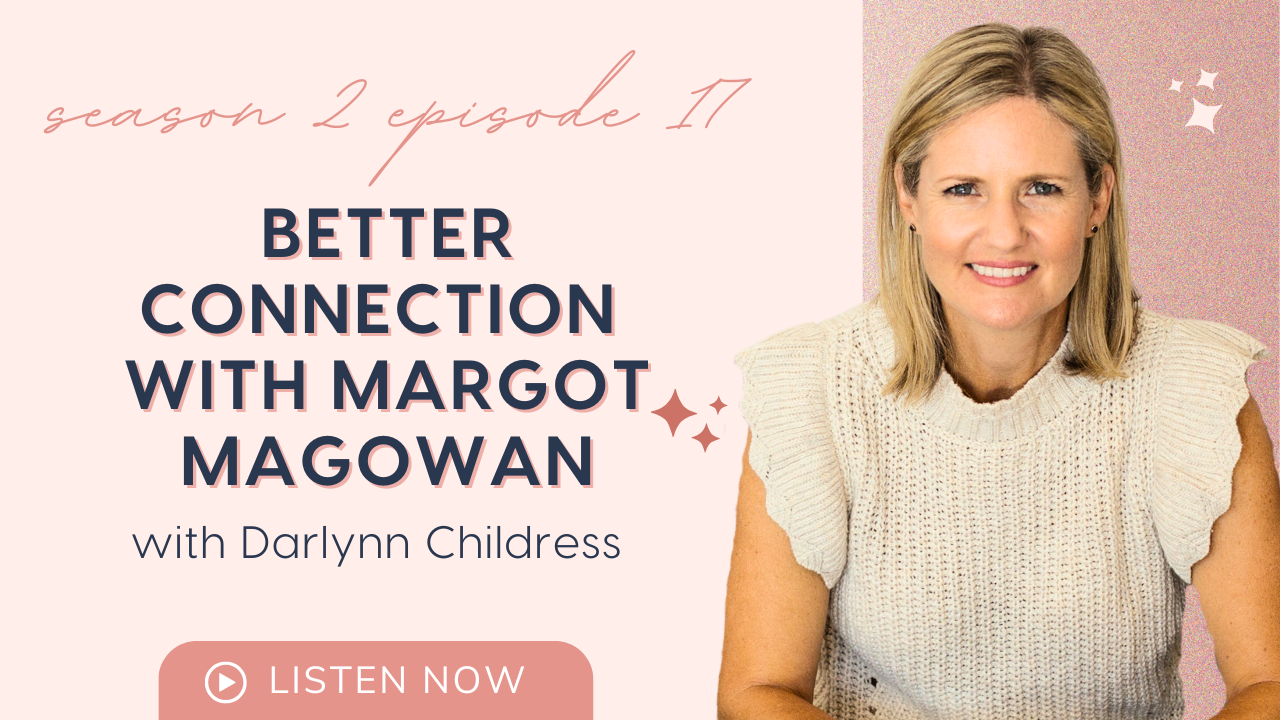
Nonviolent Communication for Moms with Margot Magowan
Apr 29, 2026Follow the Show
Apple Podcasts | Spotify | Everywhere else
If you listen to this podcast or have worked with me in any of my programs, you are already practicing Nonviolent Communication (whether you realize it or not). Today’s guest, Margot Magowan, is an expert on Nonviolent Communication, and she’s here to show you how to use those principles for better connection with your kids.
Margot Magowan, a mom of 3, says that learning about Nonviolent Communication helped to transform everything for her family. When her oldest daughter was 15 years old, she started having behavioral health challenges, like refusing to go to school, abusing drugs, and stealing. Over the course of 3 years, she went to various wilderness and residential programs, receiving access to all kinds of support and resources.
Now, at age 22, Margot’s daughter is thriving. She says, “I really credit it to me and my husband learning how to listen to her.” In her coaching practice, Margot supports other parents in learning how to truly listen to their children with presence and curiosity.
The Basics of Nonviolent Communication
Nonviolent Communication (NVC) was created by Marshall Rosenburg, who believes that all human behavior is motivated by an attempt to meet certain universal needs.
Margot explains that NVC is made up of 4 parts: observations, feelings, needs, and requests.
Take the example of you and your partner getting ready to go to a party, and you’re worried you’re going to be late. Instead of saying, “We’re gonna be late. Hurry up!”, using NVC might look like this:
- Observation - The invitation says 7:30, and it’s 6:30 now
- Feeling - I’m feeling anxious
- Need - My need for security isn’t being met
- Request - Would you be willing to leave in 15 minutes?
Margot says that when she first learned this, it felt a little robotic (and her kids hated it when she talked to them that way). She says that what really helped it to feel more authentic was when she focused on her energy rather than her language.
Basically, it’s not about the script. It’s about focusing on connection. This is called NVC Consciousness, which Margot explains as “being open and curious and present and compassionate to whatever is happening.” You’re not trying to fix anything (sound familiar?).
It goes hand in hand with the Connection Tool that I teach. You’re going into the situation as a neutral witness and viewing your child’s behavior as an expression of needs or feelings that they don’t know how to handle.
Ultimately, Nonviolent Communication is:
- Focusing on your feelings
- Identifying the universal needs underneath those feelings
- Expressing that truth honestly, while staying connected to a person's humanity
It’s important to keep in mind that the goal of NVC is not to get to the other emotion. Or to get compliance out of our kids. Although these things do sometimes often happen when we show up in a compassionate way.
The Universal Needs
There are quite a few universal needs within NVC (if you want to see them all, Margot has a free list for you here). She helped us out by breaking it down into a few key categories:
- Connection
- Meaning
- Autonomy
- Honesty
- Physical Well-Being
- Peace
- Play
For example, if you walk into your child’s room and find them lying in bed when they’re supposed to be cleaning their room, your first thought might be, “Ugh, my kid is lazy. They’re not doing what they’re supposed to do.”
After that initial thought passes, ask yourself, “What need are they trying to meet?” Maybe it’s comfort or ease, and this is their best strategy to do that. Then, you can look at the behavior through a more neutral lens.
And as a parent, if you’re feeling angry, resentful, or frustrated, you probably have some sort of need that’s not being met. Be really gentle with yourself in wondering why the situation is upsetting you so much.
Margot says that NVC has made her more aware of her own needs and how to get them met. She says, “I was using all 3 of my kids to meet my own needs…I didn’t need to shift my kids’ behavior to meet my needs.” She figured out new strategies to take care of herself.
Now, she sees that a lot of moms hold to strict rules for their kids because they are trying to meet their own need for safety. If you find yourself being rigid somewhere, ask yourself, “What am I scared of? What am I making this mean?”
This is how you get to CALM. By managing your own needs and taking care of yourself, you can then show up in a connected, compassionate way for your child.
The Giraffe and the Jackal
In Nonviolent Communication, Marshall Rosenberg uses two animal metaphors: a Giraffe and a Jackal.
The Giraffe is compassionate, open, and curious. The Jackal is more judgmental and angry.
One of the things that Margot coaches parents on is spending time with the Jackal when it shows up. And how to get your needs met from someplace other than your kid (having a safe container, like a coach, to bring these feelings and needs to is super helpful).
You can ask for this clearly if you’re talking to your partner or a friend. Say something like, “I just want empathy. I just want you to listen to me and not try to make it better or fix it or take it away.” You can also do this for yourself in a journal if you need to.
Here’s the magic. When you show up as the Giraffe and listen to your kid and they feel safe and their nervous system regulates, they reach that state of compassion and curiosity in themselves. Margot says, “I feel like we're doing such a service of actually modeling how to show up for them so they can show up for themselves and be healthy adults.”
Challenging Change
There is a real obstacle that happens when we change our parenting. Our children want what is reliable and predictable. So even if you’ve been yelling, this is what they know and expect. When you change your behavior, your kid might not feel like it’s trustworthy or safe right away. It’s unfamiliar, like you’re an imposter. It freaks them out.
Margot explains that her kids thought the yelling parents were the authentic ones. They didn’t totally trust them when they stopped yelling and started trying this new approach.
Your child might even try to pull you back into your own pattern. Their behavior will escalate and they’ll almost want you to yell, because that’s what they’re used to. You have to restrain yourself and stay within your new value system long enough to get all the way through that emotion.
Eventually, they will catch up to the new version. And they’ll really like this calmer, more connected parent that you’re becoming. It just takes some time.
Doing something different isn’t always easy in the short term, but the long term gains are so worth it.
You’ll Learn:
- The basic principles of Nonviolent Communication and how to use them in parenting
- Examples of using NVC in real-life situations
- Ways that your own needs show up in your parenting (and healthier ways to meet them)
- How to focus on how your child is feeling, even if their story isn’t totally factual
Related Episode:
- Episode 2.16 - The Connection Tool [New & Improved]
Connect with Margot:
- Get the “Feelings & Needs List” that Margot talked about in this episode at https://listen2connectcoach.com/resources
- Follow Margot on Instagram @listen2connectcoach
- Learn more about her coaching, workshops, and more at https://listen2connectcoach.com/
Ready to stop yelling?
Get the one simple tool you need to stop yelling at your kids, so you finally feel calmer and connect better.
You'll learn why you yell, how to stop yourself yelling, 40 things to do instead and scripts for what to say to your kid when you yell.
