
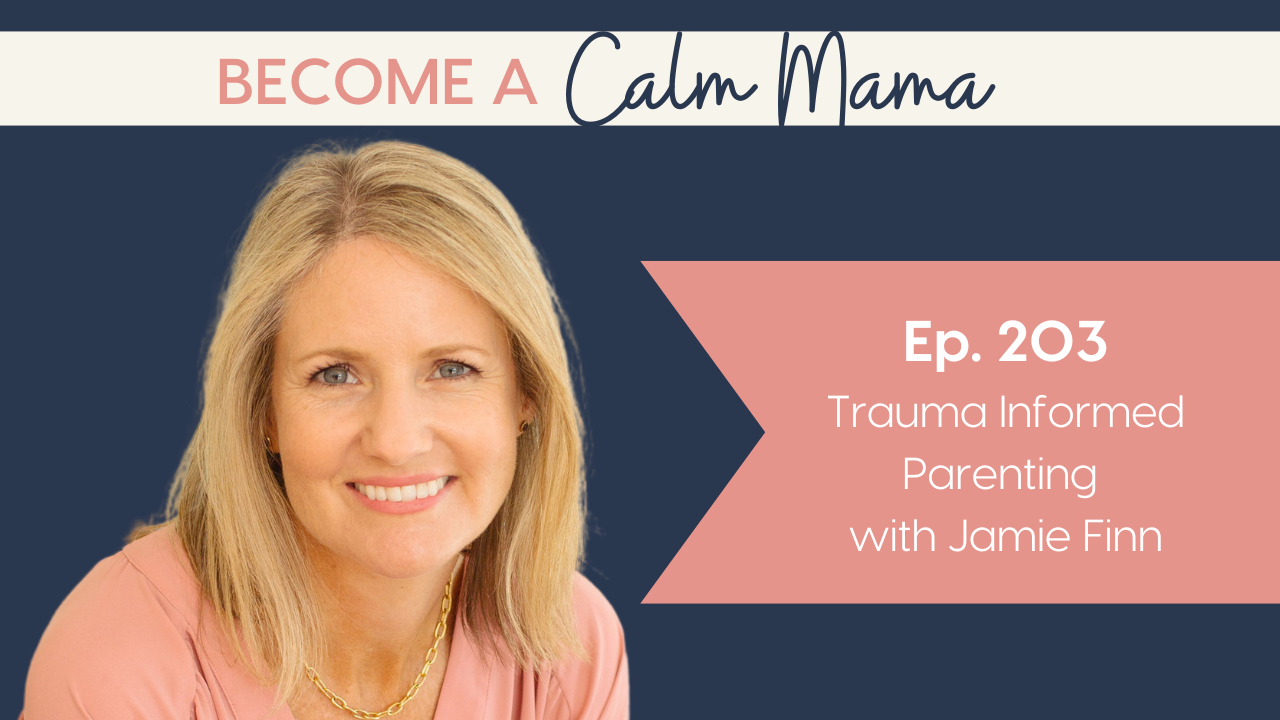
Trauma Informed Parenting With Jamie Finn
Dec 10, 2025Follow the Show
Apple Podcasts | Spotify | Everywhere else
When a kid has experienced trauma, their nervous system often fires in ways that are unpredictable, intense, and challenging. Today, my guest Jamie C. Finn is sharing trauma-informed parenting techniques to help you and your child be better regulated.
I invited Jamie to the podcast because she is a foster parent, an adoptive parent, and a parent of children she has birthed (7 kids total!). And she has a lot of experience raising kids who are neurodivergent and have a history of trauma. We cover a lot of ground in this conversation, really drilling down to what it means to be a mom.
Jamie C. Finn has written 3 books: Foster the Family, Filled, and God Loves Kids. She is also the founder and president of Foster the Family, a national nonprofit that serves vulnerable children and the families welcoming them, as well as the founder of the Filled Gathering, the largest gathering of foster and adoptive moms in the world.
Meet Jamie C. Finn
Jamie’s family started out as something pretty conventional, but has grown into so much more. 11 years ago, she and her husband had 2 kids - one boy, one girl - living the American dream. Today, they have 7 children ranging in age from 2 to almost 17, including 4 kids that they adopted through foster care, and 1 in a current foster placement. She says it became a life of “keeping our doors open to kids who need us.”
She came from a background of conservative, traditional, gospel-centered Christian parenting. And while Jamie still draws heavily from her faith and religion, her approach has changed drastically over the years.
The first parent training she ever went to was very authoritarian, and she was immediately uncomfortable with the strategies she was being taught. But Jamie’s first trauma-informed training opened her eyes to a whole new way of thinking about her kids and their behavior. She was amazed to learn that a trauma-informed approach also worked with her biological child who struggled with ADHD and anxiety.
She says, “This isn't just about trauma. This is about seeing our kids’ brains and meeting our kids where they are.” It’s not about getting immediate obedience. It’s more like saying, “My heart is for you and I'm with you and I want you to be able to succeed in obedience.” She’s now been on a journey for the past 11 years of learning to love and parent her children well and helping other families to do the same.
The Power of Curiosity
When I looked up “trauma-informed parenting”, I found that it was “based on the concept that behaviors are often windows into underlying emotions or unmet needs.” And I thought, well that just sounds like human-informed parenting to me.
To some extent, Jamie agrees. She says that she doesn’t change the way she parents based on whether a kid has experienced trauma or not. She still wants to understand the need and how she can help them meet it.
However, she believes that the curiosity goes deeper in a trauma-informed approach, especially when you don’t have the child’s full history. She says, “It leads to curiosity, which leads to generosity, which leads to meeting that need.”
This curiosity can almost be harder to access with neurotypical, biological kids. It’s easier to expect them to have it all together. But even if their story, brain, and biology are typical, there are triggers that come up from their hormones, diet, school, schedule, friendships, sleep, etc. There is still plenty of room for curiosity about what is behind the behavior.
I like to think of it as the journey to compassion.
Judgment >> Neutrality >> Curiosity >> Compassion
Curiosity always comes before compassion. It’s looking for a genuine answer to “Why are you acting this way?” Jamie says that “our kids usually can’t answer [that question]. That’s why it’s our job to be little detectives.” Is it coming from something that happened at school today, last week, or from a trauma in their story that happened 10 years ago?
Even when you can’t find the answer, Jamie says, ask yourself, “How can I look at them as a full person who needs compassion right now?”
Trauma-Informed Parenting Tools
The thing about trauma is that it actually rewires the brain. It makes the parts of the brain that are reactive bigger and more reactive. And it makes the parts that are thoughtful and do good planning and thinking smaller and less potent. Essentially, the brain is wired to get afraid and activated and stay that way.
I like to use the visual of a cup with the liquid being stress. A neurotypical, non-trauma kid has some liquid in their cup, but there’s still some room. Someone with neurodivergence or a history of trauma has a cup that stays pretty full, so when you add a stressor or stimulation, it overflows easily.
As a result, it takes a lot more work to keep the nervous system regulated. And it’s also much more important to stay regulated.
Jamie says that learning about trauma-informed parenting changed the way she parents ALL of her kids. Ultimately, it comes down to regulation. The tools she uses don’t necessarily depend on whether the child has experienced trauma or not. They’re more geared toward the age of the kid and what works for each individual.
One simple tip is that Jamie likes to use the word “dysregulated” with her kids, rather than labeling a specific emotion. She says, “It is easy to be defensive of the idea that you're in a bad mood or you're being mean or you're angry.” Using the word “dysregulated” tends to bring those defenses down a bit. In my family, we tend to use the word “overwhelmed” in this same way. It’s more like, “Let’s take a minute. I want to help you calm down.”
Staying Regulated as a Mom
Your kid’s trauma or neurodivergence doesn’t just affect them. Jamie says, “All of your kid’s triggers are now your triggers,” because you are now managing your kids and their stressors and triggers. And that keeps your stress cup brimming, as well. It increases your cortisol levels, changes your brain chemistry, and keeps you more activated.
When you’re not having a “typical” experience of motherhood, it can feel really hard. You feel different because your experience literally is different. It often feels like no one understands - teachers, playgroups, even parent educators.
You’re not crazy. The work is objectively harder. You have to work harder at calming yourself and calming your child.
Jamie says that parenting 7 kids has been a journey. She’s fallen on her face, dragged herself back up, and realized that something needed to change. One insight I love was when she said, “The expectation can't be that the kids are going to be the ones who are going to change. It needs to be me.”
She realized that she needed to do something about her stress level because her kids were hijacking her nervous system every 5 seconds. She realized that she needed to take care of herself in every way - mentally, emotionally, physically, spiritually - so that she could show up for her kids. She says, “When I show up for this 125% job at 50%, it's just not going to work.”
Now, Jamie says, “For me to stay regulated is far easier than for me to become dysregulated and then have to reregulate.” She thinks of it like a prescription. Some daily actions that help are getting plenty of sleep, going for a daily walk, and reading her bible. She also goes to therapy and spends time with “her people”.
Jamie says it was a huge pressure, but she knew that if she wasn’t regulated, her children would stay in their dysregulated states forever. Once she started seeing herself as the cornerstone, it became clear what needed to change. And the change has been dramatic.
Jamie says that the true difference, now that the focus is on regulation rather than obedience, is “we don’t have a home of chaos. Yeah, we have a home of individuals who struggle in different ways at different times. And then we come back down and we have a home of peace and joy.”
Creating a Rhythm of Care
Jamie explains that when you have trauma and dysregulation in your home, it can leave you feeling completely out of control. You become a victim to everything going on around you. But you actually have the power to change the dynamic in your home.
There are SO many great regulation strategies out there, but often 1 or 2 things work best for an individual.
Jamie and I agree that a great place to start is, “move your body, move your mind”. And the good news is that all of these strategies build on each other. One small thing can help you feel a little better, have a little more capacity and energy. The more often you come back to a regulated baseline, the longer you’ll be able to stay there.
Making one choice, doing one good thing for yourself, makes it easier to make more good choices. And once you get into a rhythm, something like your daily walk, morning journal, or evening meditation becomes a normal practice. It’s built in, and you don’t have to fight for it day after day.
Some great strategies to try out are walking (or other rhythmic movement), having time for quiet, reflection, prayer, or meditation, and journaling.
I want to leave you with a few key thoughts that Jamie and talked about that you can borrow when things feel like too much:
- I can make a difference in the dynamic of my home.
- This is pain talking. (When you see misbehavior)
- There’s nothing to panic about. This is not an emergency.
- My body is safe.
- I'm okay. We're okay. It's okay.
You are important, Mama. And taking excellent care of yourself allows you to do the same for your kids and loved ones. Wishing you curiosity, generosity, compassion, and lots of joy.
You’ll Learn:
- How your curiosity can shift your kid’s behavior
- The benefits of staying regulated (even when it feels like a lot of work)
- Why caring for your nervous system is the most important thing you can do for your home…and how to do it
- Powerful mindset shifts that will change the way you show up as a mom
Connect with Jamie:
- Read Jamie’s books, including the newest, God Loves Kids
- Follow Jamie on IG @fosterthefamilyblog
- Listen to the Real Mom podcast: https://www.realmompodcast.com/
- Learn more about Foster the Family at https://www.fosterthefamily.org/
- Get details on the 2026 Filled Gathering
Ready to stop yelling?
Get the one simple tool you need to stop yelling at your kids, so you finally feel calmer and connect better.
You'll learn why you yell, how to stop yourself yelling, 40 things to do instead and scripts for what to say to your kid when you yell.
