
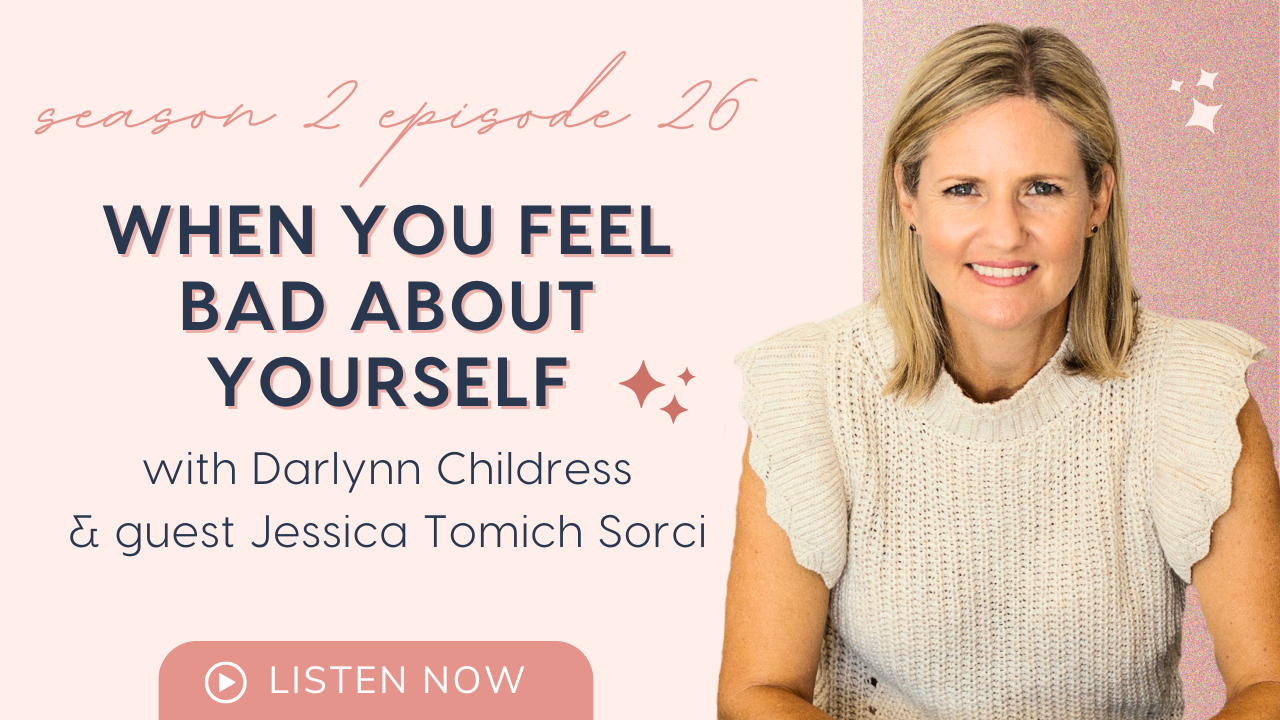
When You Feel Bad About Yourself | Confident Parenting with Jessica Tomich Sorci
Jul 01, 2026Follow the Show
Apple Podcasts | Spotify | YouTube Podcasts | Everywhere else
If you’re listening to this podcast (or reading the blog or watching on YouTube), I know a couple of things about you…
I know that you’re a great mom.
And you probably often feel bad about yourself. You think you’re not doing a great job at being a parent.
I’ve talked to a LOT of moms over the years, and mom guilt is so pervasive in our world. It’s so easy to feel like you can never measure up. That you’re not doing it “right”.
It’s easy to forget that you are an actual human raising other little humans who don’t know how to regulate themselves yet.
Today, I’ve invited Jessica Tomich Sorci on the podcast to help me normalize everything you’re going through and give you a really great tool to improve your relationship with yourself as a mom.
Jessica Tomich Sorci is a licensed marriage and family therapist, as well as a specialist in Internal Family Systems (IFS). Her focus is on maternal mental health. She’s here today talking about her new book, When Good Moms Feel Bad: An Empowering Guide to Transforming Guilt, Anxiety and Anger Into Compassion, Confidence and Connectedness, which she wrote along with Rebecca Gushuri.
She says her goal in writing this book was to help moms discover a path to trusting themselves, respecting themselves, and reclaiming some empowerment around what might feel crazy or out of balance.
Jessica’s going to show you how to drop the guilt so that you can connect with and calm the part of you that is stressed out and overwhelmed.
Getting to Know Your Mom Parts
IFS uses the term “parts” to talk about different aspects of yourself. You can almost think of your individual parts as people. When you separate it out, you might start to see a protective part, a fearful part, an angry part, etc. Your parts respond and react to their environment. And all of these are separate from your core Inner Self.
When you first become a mom, you are responsible for another creature 24/7. Jessica says that everything in your nervous system is holding this immense responsibility. You not only have to regulate yourself, but also your child. It’s practically impossible, so your parts show up to help.
Imagine that one part is doing one job. For example, your anxious part is trying to keep your kid safe. Jessica says that when we look at our reactivity and what’s bubbling up inside of us from a psychological perspective, we can get curious about which parts of us are reacting.
That curiosity looks like asking ourselves:
- What's the story I’m telling myself?
- What am I reacting to?
- What part of me is reacting? What part of me did that yelling?
- What part of me is feeling threatened?
- What is that reactivity trying to accomplish?
There are 4 very common parts that show up in moms:
- The Controller Part
- The Angry Part
- The Caretaker Part
- The Anxious Part
You might not like these parts of yourself. But in her book, Jessica describes each of these parts and the ways in which they are actually trying to help you. There is a way that you can trust each of these parts and soften toward them.
When you see a mama who is overwhelmed and reactive and yelling and stressed and frustrated, it looks like anxiety, high control, or anger, but it's not. Underneath all of that is the intention of protection and love.
Connecting With Your Inner Mom
Your Self is separate from your parts. Jessica often refers to this as your Inner Mom. Some people think of it as God. It’s that truest part of you. Who you are at your core.
Self energy is not a skill set. It’s a field of energy that is calm, curious, connected, courageous, and creative. But it gets blocked when we’re in protective mode. The good news is that there are skills we can learn to help us tap into that energy more easily.
Unblending & Befriending
IFS uses the term “befriending” to talk about looking at a part of ourselves that we might not love and seeing its value. We stop judging it, befriend it, and then offer it new information or an upgrade. That part can have a beautiful conversation with your true Self, your inner mom.
Unblending complements befriending. It happens when you’re able to get a little distance from your reactivity and start untangling where different energy, feelings, and thoughts are coming from.
Unblending comes first. It can happen in a single situation. Befriending, on the other hand, takes time. It’s creating a relationship with individual parts of you.
When you view each of your parts as their own entity, it becomes a little easier to visualize. Jessica gives the example of your child walking ahead of you on the sidewalk, out of reach, and your anxious part shows up. You feel that nervousness in your body.
First, you notice it. Then, when you’re able to get curious and take a genuine interest in what’s happening and why - that’s when your Inner Mom enters the conversation. She asks questions like, “What do you think is going to happen if this anxious part is not running the show?” And she can also validate those feelings and fears.
It’s like being your own compassionate witness, your own friend. Here are some ways to unblend and befriend your mom parts.
Trust that your parts have wisdom. Even the anxious, controlling ones. They all have good intentions.
Your parts need validation and curiosity. We’re often quick to think there’s something “wrong” with us when we feel or act controlling, worried, or angry. But trying to make these parts go away actually just turns up the volume.
Instead, try asking your anxious or controlling part, “What story are you telling?” It’s usually going to be a story from our own past. Jessica says that as you dig deeper and get to know your parts, “A really exciting kind of portal opens up for moms around deep, deep healing of our own history.”
You start to see that your scared parts, sad parts, and grief are coming from your own life, but they are not your child’s story. Their story will be different from yours. But if you haven't come to terms with your own story, it will show up in your parenting and get layered on to your kids.
Let go of perfectionism. We all have wounds that we need to heal, and we all show up sometimes in wounded ways. Jessica reassures us that, “It couldn't really be any other way, because you, as a human being, have a right to your own developmental trajectory. How were you not gonna bring in what you brought in? How were you not gonna continue to work with that material in motherhood? That's what you had.”
Moms are not meant to deliver perfection. Our kids are entitled to have their own wounds, their own story. This world is a tough place. Jessica says, “We’re not here to be perfect. We're here to develop better ways of loving on ourselves, bringing compassion to the pain that we all have, and starting to be more humane with ourselves and each other.”
I'm so grateful to my children for all of their challenges and for everything that they have taught me and continue to teach me.
I want to leave you with some of Jessica’s parting words: “Motherhood heals us in the process, and we become more whole ourselves.”
What a beautiful thought. I wish healing and wholeness for you, too, Mama.
You’ll Learn:
- How to have a better relationship with yourself as a human, a woman, and a mom
- What being an empty-nester looks like for me right now
- What I like to say to myself when I’m feeling anxious
- Ways to love all the parts of you - even the challenging ones
- What surprised me about my Mom Parts assessment
Related Episodes:
- Episode 183: Internal Family Systems (IFS, part 1)
- Episode 184: Finding Your SELF (IFS, part 2)
- Episode 185: Being What Your Kids Needs (IFS, part 3)
- Episode 197: Freedom From the Good Mom Myth with Dr. Angele Close
- Episode 198: Letting Go of Mom Shame with Dr. Angele Close
Connect with Jessica Tomich Sorci:
- Take the Mini Mom Parts quiz (and listen to the full podcast episode to hear Darlynn’s results!)
- Get the book - When Good Moms Feel Bad: An Empowering Guide to Transforming Guilt, Anxiety and Anger Into Compassion, Confidence and Connectedness
- Follow Jessica on IG @jessicatomichsorci
- Learn more on her website: https://www.jessicatomichsorci.com/for-moms
Ready to stop yelling?
Get the one simple tool you need to stop yelling at your kids, so you finally feel calmer and connect better.
You'll learn why you yell, how to stop yourself yelling, 40 things to do instead and scripts for what to say to your kid when you yell.
